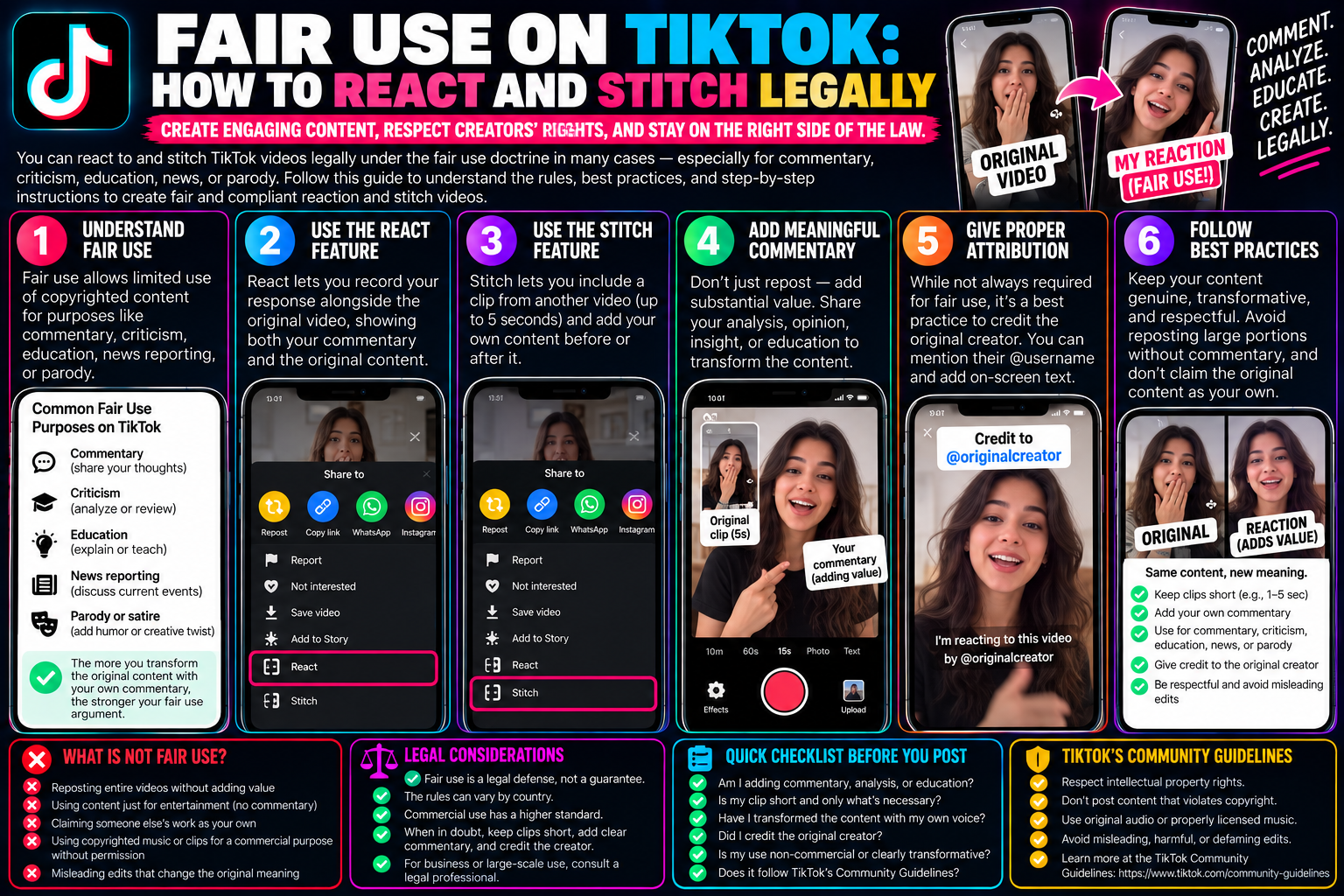
Fair Use on TikTok: How to React and Stitch Legally
Short-form video feeds thrive on interactive commentary: reacting to hot takes, stitching debates, breaking down viral news clips, and analyzing pop culture moments. Native tools like TikTok Stitch and Instagram Remix encourage creators to build directly on other users’ media.
However, stepping outside native in-app tools to download clips, edit them into third-party timelines, and re-publish them across YouTube Shorts, Instagram Reels, and TikTok introduces significant legal friction. A common misconception among creators is that adding a small face-cam in the corner, nodding along silently, or pasting a boilerplate disclaimer (“No copyright infringement intended”) grants immunity from copyright strikes.
In reality, copyright law does not grant automatic permission just because a video is short. Navigating reaction and stitched content safely requires understanding the four legal pillars of Fair Use, the mechanics of transformative commentary, and how automated content filters evaluate secondary creations.
1. What Is Fair Use? The Four-Factor Balancing Test
In United States copyright law (and similar “Fair Dealing” frameworks internationally), Fair Use is an affirmative legal defense that permits the unlicensed reuse of copyrighted material under specific, limited conditions.
Courts do not decide fair use based on a fixed length (e.g., the myth that “under 5 seconds is automatically fair use” is false). Instead, judges evaluate four statutory factors on a case-by-case basis:
| Fair Use Factor | Legal Question Evaluated | What Strengthens Your Position | What Weakens Your Position |
| 1. Purpose & Character | Is the new work transformative, commercial, or educational? | Adds clear critique, parody, analysis, or historical context. | Passive watching, silent reaction, or raw aggregation. |
| 2. Nature of the Source | Is the original work factual or highly creative? | Quoting factual news reports, public speeches, or press events. | Copying cinematic movies, artistic choreography, or unreleased music. |
| 3. Amount & Substantiality | How much was taken, and does it take the “heart” of the work? | Using only the brief seconds necessary to illustrate the point. | Playing an entire routine or including the core punchline/climax. |
| 4. Market Effect | Does your clip substitute for the original work in the marketplace? | Viewers still need to seek out the original creator for the full experience. | Viewers no longer need to watch the original because you showed it all. |
2. “Transformative” vs. “Derivative”: Where Reaction Content Crosses the Line
The cornerstone of modern fair use doctrine is transformativeness. For a reaction video to be transformative, it must alter the original media with new meaning, new critical perspective, or distinct commentary.
In the landmark digital video copyright case Hosseinzadeh v. Klein (the H3H3 reaction lawsuit), a federal court affirmed that reaction videos can qualify as fair use when the creators incorporate short clips strictly to critique, mock, or analyze specific claims made by the original author.
Conversely, in Equals Three, LLC v. Jukin Media, courts ruled that episodes where a creator simply played viral clips for entertainment without providing substantial critique or commentary were not fair use because they failed the transformation test and competed directly with the licensed media.
The Passive Reaction Trap
-
High Risk: Placing an unedited 45-second TikTok in full screen while your face sits in a small picture-in-picture circle, occasionally smiling, nodding, or gasping. This does not transform the work; it merely re-broadcasts someone else’s intellectual property.
-
Legally Defensible: Playing a 4-second excerpt of an educational or opinion clip, immediately pausing the playback, breaking down the inaccuracy of the speaker’s claims, offering supporting data, and resuming. The original video serves solely as the target of your critique.
3. Native App Tools vs. Independent Video Downloads
Platform features like TikTok Stitch, Duet, and Instagram Remix operate under a Terms of Service (ToS) license. When an author publishes a video with “Allow Duet/Stitch” toggled on, they grant other users within that app an express license to incorporate their video using native features.
However, when you:
-
Copy the link of a viral clip.
-
Download the MP4 file using an external web downloader like tiksave.org.
-
Import that clip into Premiere Pro or CapCut to edit a reaction.
-
Upload that newly edited file across TikTok, Shorts, and Reels.
You are no longer operating under the in-app platform license. You are acting as an independent publisher relying entirely on statutory Fair Use.
Rules for Safely Repurposing Downloaded Clips:
-
Clip Only the Specific Claim: Do not download a 60-second video and replay 50 seconds of it. Use tiksave.org to download the high-res file, bring it into your editor, and trim it down to the exact 3- to 6-second statement you are addressing.
-
Use Split Pacing: Intercut the subject’s words with your own voiceover. Never let the source video run uninterrupted without accompanying analytical commentary.
-
Attribute the Creator: Mention the creator’s handle in your caption and voiceover. While attribution alone does not legally excuse copyright infringement, it establishes good faith and prevents audiences from assuming you are plagiarizing the footage.
4. The Audio Hazard: Why Music Breaks Fair Use Defenses
Video commentary enjoys broad protections under criticism and educational exceptions, but background music is an enforcement hotspot.
If the TikTok you are reacting to features a licensed pop song playing in the background:
-
Automated matching engines (such as YouTube’s Content ID or Meta’s Rights Manager) do not recognize visual nuance. They detect acoustic audio fingerprints within milliseconds.
-
Record labels enforce near-zero-tolerance policies for automated acoustic matches.
-
Even if your verbal commentary over the video is legally defensible fair use, the background music playing beneath the speaker will trigger an automated mute, demonetization, or regional block.
The Fix: When reacting to a clip that contains background commercial music, use audio isolation tools or low-pass filters in your video editor to reduce the music track, mute the audio entirely and quote the speaker with on-screen text, or restrict your clips to moments between musical phrases.
5. Creator Best Practices Checklist for Reaction Videos
Follow these operational guidelines before publishing secondary commentary:
-
Keep the Source Brief: Restrict third-party footage to the absolute minimum necessary to give context to your critique.
-
Prioritize Substantive Commentary: Ensure your original speaking time and analytical input account for the majority of the video’s total runtime.
-
Never Substitute the Market: Ask yourself: “If someone watches my reaction, will they still have a reason to watch the original video?” If your video spoils the surprise, punchline, or core payoff, you have harmed the original creator’s market.
-
Scrub Third-Party Watermarks Carefully: When importing fair-use clips, avoid stretching or distorting frames to hide creator handles. Instead, cite the creator explicitly on screen.
Frequently Asked Questions
Does putting “No copyright infringement intended” in my caption protect me?
No. Disclaimer phrases carry zero legal weight in court. If a secondary video fails the four-factor fair use balancing test, writing a disclaimer does not shield an account from DMCA takedown notices or platform strikes.
Is making a video non-profit or unmonetized an automatic fair use defense?
No. While non-commercial and educational uses receive more favorable consideration under Factor 1 (Purpose & Character), they are not exempt from infringement claims. If the upload damages the original owner’s audience or market value, non-monetized videos can still be taken down.
What should I do if my reaction video receives a false DMCA strike?
If you believe your video meets the standards of transformative critique and fair use, you can file an official DMCA Counter-Notification through the platform’s copyright dashboard. This notifies the claimant that they have 10 to 14 business days to file a formal federal court lawsuit, or the platform must restore your video.