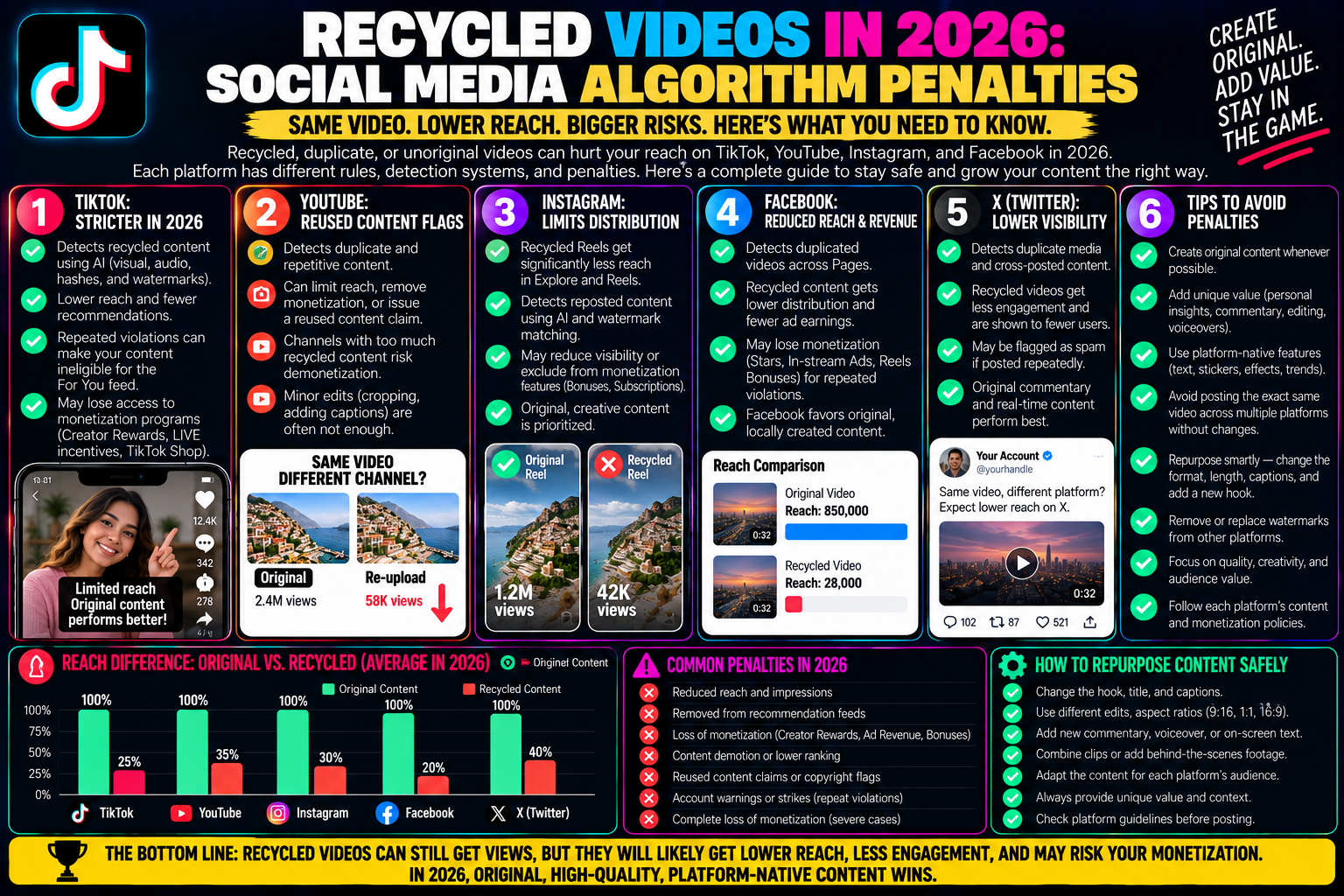
Recycled Videos in 2026: Social Media Algorithm Penalties
Cross-posting short-form video used to be simple: export a finished clip from TikTok, download it to your camera roll, and re-upload the same file across Instagram Reels, YouTube Shorts, and Facebook. In the early days of vertical feeds, platforms welcomed any high-performing video to populate their discovery tabs.
Today, that casual reposting pipeline triggers algorithmic suppression.
Short-form recommendation systems on Meta, YouTube, and TikTok now deploy multi-layered computer vision models, acoustic fingerprinting engines, and perceptual hashing algorithms to maintain content quality.
Understanding the technical mechanisms platforms use to detect recycled media—and adopting an operational workflow that circumvents these automated filters—is critical for syndicating content across multiple networks without sacrificing algorithmic reach.
The Engineering Shift: Why Platforms Filter Recycled Content
To understand why platforms penalize re-uploads, look at the business incentives driving vertical discovery feeds:
-
Competitor Brand Dilution: Serving a video with a visible TikTok watermark on an Instagram Reels feed or YouTube Shorts shelf acts as free advertising for a direct competitor.
-
Aggregator and Bot Farm Suppression: Unchecked reposting incentivizes scrapers that duplicate viral videos onto thousands of burner accounts, diluting advertiser value and degrading the user experience.
-
Bandwidth and Storage Costs: Storing petabytes of identical video files across global edge servers wastes computing resources. Platforms use deduplication hashing to identify duplicate uploads during ingest.
-
User Fatigue: Audiences scrolling through multiple apps dislike seeing the identical video, audio cue, and caption loop repeated across every platform within an hour.
To protect their ad inventory and user retention, engineering teams have turned their ingest moderation systems into automated detection pipelines.
Technical Layers Used to Detect Recycled Video
When a video upload hits the ingestion queue of Instagram, YouTube, or TikTok, it passes through four distinct verification layers before entering recommendation testing:
+-------------------------------------------------------------+
| 1. PERCEPTUAL VISUAL HASHING (pHash / Block Hashing)        |
| Generates a spatial fingerprint of keyframes & pixel layouts|
+-------------------------------------------------------------+
                             │
                             ▼
+-------------------------------------------------------------+
| 2. OCR & WATERMARK COMPUTER VISION                          |
| Edge-detection models scan for logos, icons & usernames     |
+-------------------------------------------------------------+
                             │
                             ▼
+-------------------------------------------------------------+
| 3. ACOUSTIC FINGERPRINTING & CHROMAPRINT MATCHING           |
| Analyzes audio waveforms, speech cadences & background audio|
+-------------------------------------------------------------+
                             │
                             ▼
+-------------------------------------------------------------+
| 4. METADATA & CONTAINER INSPECTION                          |
| Reads codec headers, software encoders & creation timestamps|
+-------------------------------------------------------------+
Perceptual Hashing (pHash)
Unlike standard cryptographic hashes (such as MD5 or SHA-256), which produce a completely different string if a single pixel changes, Perceptual Hashing (pHash) produces matching or near-matching mathematical values if two images look visually similar to human eyes.
The system downsamples video frames into low-resolution grayscale matrices, extracts luminance gradients, and generates a structural fingerprint. If your cross-posted video matches an existing file in the platform’s database with an 85%+ similarity score, it is flagged as duplicate media.
Optical Character Recognition (OCR) and Logo Classifiers
Neural network classifiers (such as YOLO and specialized convolutional neural networks) are trained to detect platform logos, animated corner badges, and bouncing handles.
-
Models scan boundary margins where watermarks typically sit (e.g., top-left, bottom-right).
-
Even if a creator blurs, crops, or covers a logo with a sticker, edge-detection algorithms flag the irregular pixel density or artificial blur patch as an attempted bypass.
Acoustic Waveform Matching
Audio is scanned using spectrogram fingerprinting (similar to Shazam and YouTube Content ID).
-
The system maps peaks in frequency over time.
-
If your audio track contains a licensed TikTok sound, a trending voice filter, or an identical waveform that matches an existing index without platform-native sound attribution, the system flags the file as an external re-upload or mutes the track entirely.
File Headers and Container Metadata
Raw video files contain EXIF and container metadata inside the MP4 wrapper:
-
Encoding software used (e.g., TikTok in-app engine, CapCut mobile export, Premiere Pro).
-
Creation and modification timestamps.
-
Audio sampling rates and color space profiles.
A video saved natively out of TikTok’s mobile app contains specific encoder metadata strings that identify its origin before a human moderator or visual scanner evaluates a single frame.
The Consequences: How Penalties Are Applied
Platforms rarely issue formal community guideline strikes for recycled content unless copyright theft is involved. Instead, they apply programmatic penalties that suppress discoverability:
| Platform | Official Guideline Classification | Algorithmic Consequence |
| Instagram Reels | “Content that can’t be recommended” | Excluded from Explore page and Reels tab; shown only to existing followers. |
| YouTube Shorts | “Unoriginal aggregation / Low-effort” | Ineligible for Shorts Shelf promotion; excluded from YouTube Partner Program monetization. |
| TikTok | “Not Eligible for the For You Feed” | Hard view ceiling (stuck at 0–250 views); excluded from the Creator Rewards Program. |
This explains why an account can post a video that receives millions of views on one platform, while the direct re-upload on another platform plateaus at double digits. The post is not broken—it has been quarantined to existing followers.
4. The Creator Workflow: Safe Cross-Platform Syndication
Circumventing automated detection does not mean trying to trick the algorithm with low-effort hacks like mirror-flipping footage or adding rainbow borders. It requires an operational production pipeline that outputs clean, platform-native assets.
+-------------------------------------------------------------+
| 1. EXTRACT RAW HIGH-DEFINITION STREAM                       |
| Pull unwatermarked 1080p source MP4 via clean CDN parser   |
+-------------------------------------------------------------+
                             │
                             ▼
+-------------------------------------------------------------+
| 2. FRAME SEQUENCE HASH BUSTING                              |
| Trim 0.3s off ends, micro-adjust speed by 1% (1.01x)        |
+-------------------------------------------------------------+
                             │
                             ▼
+-------------------------------------------------------------+
| 3. SOUND DECOUPLING & PLATFORM RE-ATTACHMENT               |
| Keep spoken dialogue; re-link music via native audio picker |
+-------------------------------------------------------------+
                             │
                             ▼
+-------------------------------------------------------------+
| 4. NATIVE METADATA GENERATION                               |
| Re-render container; upload with platform-specific captions |
+-------------------------------------------------------------+
Step 1: Start with an Unwatermarked Master Stream
Never re-upload a clip saved using TikTok’s native in-app save utility. If you recorded your draft or initial post within the TikTok camera, extract the clean, unwatermarked source file using tiksave.org.
Step 2: Alter the Frame Hash
To prevent perceptual hashing models from classifying your file as an exact clone:
-
Trim Boundary Buffers: Cut 0.2 to 0.5 seconds off the beginning or end of your video in a mobile or desktop editor. This shifts the frame sequence indexing.
-
Micro-Speed Adjustment: Adjust playback speed to 1.01x or 1.02x. The difference is imperceptible to viewers, but it alters both the audio pitch waveform and the temporal frame cadence.
-
Slight Crop / Scale: Scale the canvas to 102%. This changes pixel coordinate arrays, breaking direct spatial matrix comparisons.
Decouple and Re-Link Audio Natively
If your video features commercial background music, export your video master with spoken vocals only.
-
Upload the clean vocal MP4 to Instagram Reels or YouTube Shorts.
-
Open the destination platform’s native sound picker and search for the matching music track.
-
Lower the platform music track volume to 10% and keep your original vocal audio at 100%.
This simple step credits the sound legitimately under each platform’s internal music licensing system, connecting your post to that audio’s active trend hub while eliminating automated copyright mutes.
Frequently Asked Questions
Can adding a colored border or mirror-flipping a video fool modern detection algorithms?
No. Modern perceptual hashing and machine learning classifiers are invariant to simple transformations like horizontal flips, color saturation tweaks, or border overlays. In fact, adding artificial frames often damages viewer retention, causing an immediate drop in watch time.
Does scheduling cross-posts simultaneously across three platforms trigger spam flags?
Publishing an identical video across TikTok, Instagram, and YouTube at the exact same minute does not trigger cross-platform penalties because the platforms operate completely independent server architectures. However, staggering uploads by 2 to 4 hours allows you to monitor comments and optimize captions based on early viewer reactions.
If my account receives an “Unoriginal Content” flag, how long does recovery take?
On platforms like Instagram, an account status flag typically persists for 30 days. To clear the restriction, delete or archive the flagged post, maintain a clean posting history of original, watermark-free videos, and check your status dashboard under Settings $\rightarrow$ Account Status until green checkmarks return.