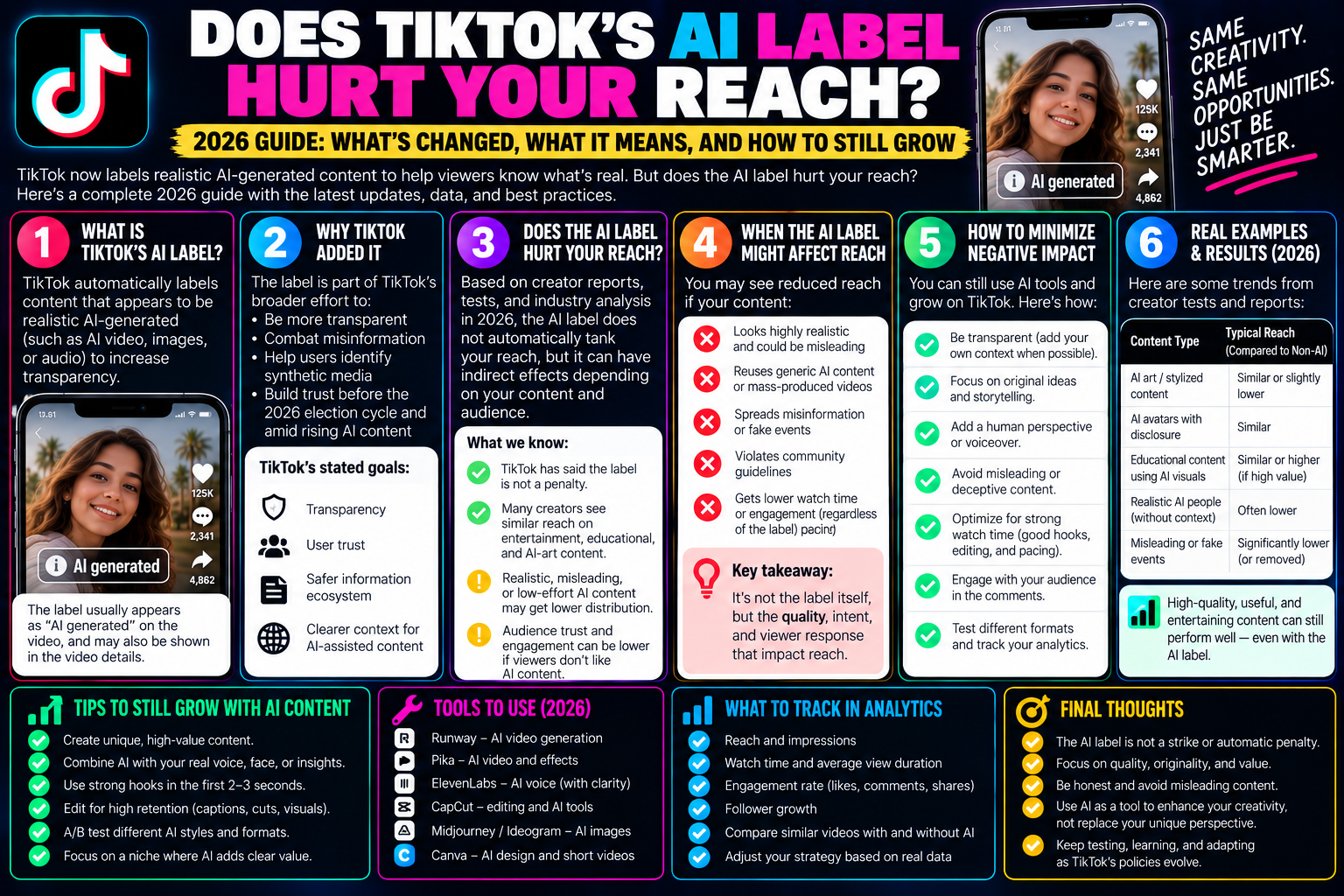
Does TikTok’s AI Label Hurt Your Reach? 2026 Guide
Generative artificial intelligence has permanently reshaped short-form content creation. From synthetic voice clones and digital avatars to photorealistic b-roll and automated scripts, creators now assemble complex videos in minutes.
However, seeing the gray “AI-generated” or “Creator labeled as AI-generated” badge pop up on your video upload often comes with anxiety: Did that single tag just kill my algorithmic reach?
Online creator forums frequently treat the AI label like a digital penalty box, claiming that toggling it on suppresses For You Page (FYP) distribution.
Separating myth from reality requires examining how TikTok’s detection architecture works, how the algorithm treats synthetic metadata, the behavioral psychology of viewer drop-offs, and where the line between acceptable AI assistance and penalized synthetic media actually lies.
1. How TikTok Automatically Detects and Flags AI Media
Many creators assume TikTok operates solely on the honor system, relying on users to toggle the “AI-generated content” switch manually during upload.
In reality, TikTok deploys a multi-layered automated detection pipeline that identifies synthetic media even when creators attempt to hide it:
C2PA Content Credentials
TikTok integrates Coalition for Content Provenance and Authenticity (C2PA) standards. When you render or export visuals from tools like Midjourney, Adobe Firefly, DALL-E, or Sora, cryptographic metadata is injected directly into the image or video container. The moment you upload that file to TikTok, the server reads the provenance manifest and automatically applies the “AI-generated” label.
Acoustic and Visual Neural Classifiers
Stripping metadata does not guarantee avoidance. TikTok’s ingestion engine runs visual and acoustic verification models:
-
Audio Fingerprinting: Classifiers detect unnatural phonetic cadence, breathlessness, and spectral waveforms typical of text-to-speech voice generators (e.g., ElevenLabs, PlayHT).
-
Facial and Texture Artifacts: Computer-vision algorithms scan for irregular blending around hairlines, finger counts, warped background lines, and unnatural pupil reflections in synthetic human faces.
-
Invisible Watermarking: TikTok uses imperceptible digital watermarks embedded into pixel data and audio tracks that persist through compression, re-encoding, and basic edits.
2. Does the Label Itself Trigger an Algorithmic Reach Penalty?
The direct answer from TikTok’s technical documentation is no—the platform does not deliberately downgrade or suppress a post simply because the AI-generated toggle is active. Properly labeled synthetic content remains eligible for standard FYP distribution, TikTok Shop affiliate programs, and Creator Rewards Program payouts.
The penalty occurs when you fail to disclose.
| Content Scenario | Policy Status | Algorithmic Distribution Impact |
| Proactively Disclosed AI | Fully Compliant | Eligible for normal FYP distribution; reach determined by user engagement metrics. |
| Undisclosed AI (Detected via C2PA) | Non-Compliant | Video distribution restricted; content barred from non-follower recommendation feeds. |
| Undisclosed Realistic Deepfakes | Severe Violation | Immediate video removal, account strikes, and potential 30-day shadowban or termination. |
| AI Text Assistance (Scripts, Hooks) | Policy Exempt | Zero labeling required; treated as 100% human-generated media. |
If TikTok’s automated scanners detect synthetic media that was deliberately uploaded without the required disclosure, the algorithm suppresses the post’s distribution as a moderation safeguard. Proactively toggling the label protects your standing and avoids automated suppression.
3. The Real Culprit: Viewer Psychology and Audience Retention
If the algorithm does not inherently throttle disclosed AI content, why do so many AI-heavy accounts experience low view counts?
The suppression is usually behavioral, not programmatic. It is driven by the interaction of the audience with two primary factors:
The “Uncanny Valley” Drop-Off
TikTok’s recommendation algorithm relies heavily on Average Watch Time and Completion Rate. If viewers swipe away during the first three seconds, the algorithm concludes the video is low quality and stops testing it with wider audience buckets.
Viewers have developed keen instincts for synthetic media. When a user spots the gray “AI-generated” tag paired with robotic eye contact, rigid vocal pacing, or generic stock animations, retention drops:
-
Industry benchmarks reveal that audience engagement drops by 15% to 25% on synthetic videos once viewers realize the creator is artificial.
-
Viewers comment less, share less to external DMs, and scroll past faster.
The algorithm didn’t kill your video because of the label; it deprioritized the video because real viewers abandoned it after two seconds.
The Feed Preference Sliders
TikTok allows users to fine-tune their feed preferences under Settings $\rightarrow$ Content Preferences. Users can actively adjust a slider to reduce synthetic media in their personal feeds. As more users choose to dial down synthetic content, the overall pool of eligible FYP recipients for AI-labeled videos naturally contracts.
4. What Requires a Label vs. What Is Exempt?
Many creators over-label their content, unnecessarily triggering user skepticism on videos that never required a badge in the first place.
+-------------------------------------------------------------+
| WORKFLOW LAYER        | EXAMPLE USE CASE        | LABEL REQ?|
+-------------------------------------------------------------+
| Ideation & Research   | ChatGPT brainstorming   | NO (Exempt)|
| Scriptwriting & Copy  | Claude-written hooks    | NO (Exempt)|
| Color & Audio Cleanup | AI noise suppression    | NO (Exempt)|
| Dynamic Subtitles     | Auto-caption generation | NO (Exempt)|
+-------------------------------------------------------------+
| Synthetic Voiceovers  | Cloned narrator voice   | YES       |
| Photorealistic Visuals| Midjourney B-roll       | YES       |
| Digital Presenters    | HeyGen / Synthesia host | YES       |
| Face Swaps / Deepfakes| Altered human likeness  | YES       |
+-------------------------------------------------------------+
The 2026 Golden Rule:
The labeling policy applies strictly to realistic visual and audio representations of people, places, or events.
If an AI tool merely assisted your workflow—writing a hook, outlining key points, cleaning up background microphone hiss, or generating dynamic typography—you do not need to toggle the AI-generated tag.
Only toggle the label when the actual sensory output (the face on screen, the environment shown, or the voice speaking) was fabricated by artificial intelligence.
5. The Hybrid Playbook: How to Use AI Without Tanking Retention
To leverage AI production speed without triggering the audience drop-off that hurts distribution, adopt the 80/20 Hybrid Strategy:
-
Human Face & Real Hook (First 3 Seconds): Always start your video with a real human speaking directly to camera or genuine physical b-roll. Securing the critical initial hook with authentic human presence keeps early retention high.
-
AI-Assisted Mid-Roll B-Roll: Use synthetic animations, AI diagrams, or stylized concepts during the middle section of the video to illustrate technical or abstract points.
-
Avoid Uncanny Hyper-Realism: If you use AI imagery, lean into stylized aesthetics (illustrations, claymation, sci-fi concept art, comic styles) rather than fake humans pretending to be real creators. Viewers engage warmly with creative animation; they swipe away from deceptive digital spokespeople.
-
Proactive Self-Tagging: When using synthetic visuals or voices, toggle the disclosure switch immediately. A disclosed post retains normal eligibility, whereas an undisclosed post caught by automated C2PA filters faces severe distribution suppression.
Frequently Asked Questions
Can AI-generated TikToks be monetized through the Creator Rewards Program?
Yes, provided the content complies with labeling guidelines and meets originality thresholds. However, repetitive mass-produced slideshows or low-effort AI aggregations face disqualification under the program’s unoriginal content rules.
If I download my TikTok and post it to Instagram Reels, will the AI tag carry over?
If you download the video natively, TikTok burns watermarks and metadata into the file. To cross-post clean media across platforms without third-party tracking, use an unwatermarked source extractor like tiksave.org to download the clean 1080p MP4.
Can TikTok remove my account for posting unlabeled AI content?
Yes. TikTok uses an escalating penalty system. First-time offenses generally result in content removal or automatic label application. Repeated violations for posting deceptive or unlabeled photorealistic synthetic media can lead to temporary posting restrictions, demonetization, or permanent account termination.