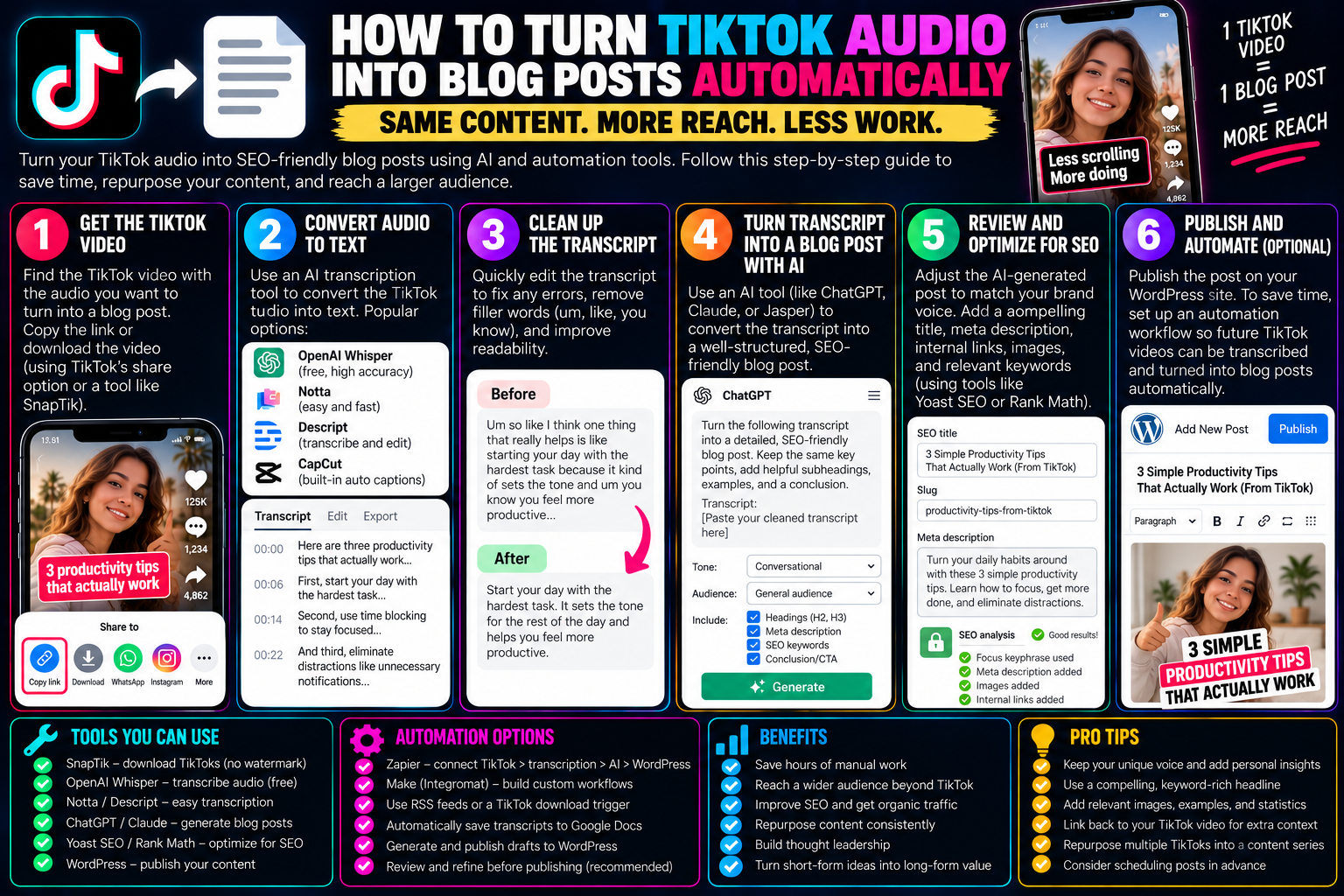
How to Turn TikTok Audio into Blog Posts Automatically
A single sixty-second TikTok video contains a dense concentration of information: a hook, a real-world problem, a step-by-step solution, and a conclusion. Yet once that video drops out of the algorithmic recommendation cycle, the spoken insights are trapped within an audio track that search engines cannot crawl, index, or rank for long-tail organic search terms. Transcribe TikTok audio to text
Transforming high-performing spoken-word videos into structured, search-engine-optimized blog articles creates an evergreen content pipeline. Instead of writing blog posts from scratch, you can convert the spoken audio of your video archive into long-form guides, tutorials, and comparison articles.
Accomplishing this at scale without manual typing requires an automated content workflow: extracting the raw audio stream, running accurate speech-to-text transcription, reshaping conversational ramblings into clear prose, and enriching the text with SEO headings and schema markup.
1. The Anatomy of Spoken Video vs. Search-Driven Text
A common mistake when transcribing video to text is dumping verbatim transcripts directly onto a webpage. Spoken video and written web copy serve different communication styles:
-
Spoken Delivery (Conversational & Fragmented): Video creators use rhetorical pauses, verbal fillers (“so basically”, “you know”), sudden tonal shifts, and visual hand gestures. A straight transcription read on a screen looks disjointed and lacks semantic clarity.
-
Search-Engine-Optimized Copy (Structured & Hierarchical): Readers scan web pages using an inverted pyramid structure. They expect logical H2 and H3 subheadings, scannable bullet points, comparative tables, and bold takeaway sentences.
The goal of an automated transcription engine is not word-for-word reproduction; it is semantic extraction and expansion. The core concepts, steps, and examples from the audio serve as the structural backbone of an authoritative 1,000+ word article.
2. Step 1: Automated Audio Extraction
Before passing audio to a transcription engine, you must isolate the cleanest possible audio container. Transcribing audio recorded by pointing a microphone at phone speakers introduces room echo, background hiss, and compression noise that degrades automated speech recognition (ASR) accuracy.
Sourcing Direct Source Streams
-
Copy the public link of the target TikTok video.
-
Use an extraction endpoint like tiksave.org to download either:
-
The watermark-free MP4 video file.
-
The direct standalone MP3 / AAC audio stream parsed from the content delivery network (CDN).
-
-
Extracting the direct audio stream avoids re-encoding losses and provides uncompressed vocals ready for machine processing.
For automated developer pipelines (built using tools like n8n, Make, or custom Python scripts), passing the video URL to an extraction script isolates the raw audio track and dumps the
.mp3 or .wav container directly into an Amazon S3 or Google Drive staging bucket.3. Step 2: High-Fidelity Speech-to-Text Processing
Once the audio file is staged, it is processed through an Automatic Speech Recognition (ASR) model.
+-------------------------------------------------------------+
| 1. AUDIO INGESTION                                          |
| Fetch clean MP3 from TikTok CDN via direct extractor        |
+-------------------------------------------------------------+
                             |
                             v
+-------------------------------------------------------------+
| 2. ASR TRANSCRIPTION (OpenAI Whisper / Deepgram)           |
| Converts raw phonemes into timecoded text with punctuation  |
+-------------------------------------------------------------+
                             |
                             v
+-------------------------------------------------------------+
| 3. LLM TRANSFORMATION & EXPANSION (GPT-4o / Claude)        |
| - Strips verbal fillers and conversational drift            |
| - Formats into H2/H3 headings and scannable lists           |
| - Expands core points into thorough, publication-ready prose |
+-------------------------------------------------------------+
                             |
                             v
+-------------------------------------------------------------+
| 4. CMS SYNC & EMBED                                         |
| Push Markdown draft to WordPress REST API with video embed  |
+-------------------------------------------------------------+
Selecting an ASR Provider:
-
OpenAI Whisper (whisper-1): At roughly $0.006 per minute, Whisper provides industry-standard accuracy, handling accented English, niche terminology, and background beats without misinterpreting spoken phrases.
-
Deepgram (Nova-2): Offers sub-second latency and lower batch rates, ideal for large catalogs where creators need to transcribe hundreds of clips in bulk.
-
Local Whisper (
whisper.cpp): For offline, free processing, running an open-source medium or large-v3 Whisper model locally on an Apple Silicon Mac or dedicated GPU server eliminates ongoing API fees.
4. Step 3: Transforming Transcripts into Long-Form Blog Posts
A raw 60-second TikTok transcript usually spans 130 to 180 words. To turn that short transcript into an indexed, comprehensive 1,100-word blog post, an LLM pipeline must handle editorial expansion.
Pass the raw transcript into an LLM using a prompt that enforces structural rigor:
Plaintext
You are an expert editorial writer and SEO copywriter.
Below is the raw, spoken transcript of a short-form video on the topic: "[Insert Topic]".

Execute the following steps:
1. Extract the core argument, step-by-step instructions, and key technical takeaways.
2. Remove verbal filler, conversational drift, and platform-specific mentions ("link in bio", "smash the follow").
3. Structure the content into a complete 1,100-word authoritative blog post using clear H2 and H3 markdown headings.
4. Expand each core point with practical context, common pitfalls, and real-world examples.
5. Include an FAQ section targeting search queries related to the primary topic.
6. Maintain an objective, educational tone with active voice.

Raw Transcript:
"""
[PASTE TIME-CODED TRANSCRIPT HERE]
"""
The Rules of Safe Editorial Expansion:
-
Preserve Creator Opinions: Ensure the article maintains the original author’s core thesis and perspective.
-
Add Depth, Not Fluff: Avoid generating padded prose. Expand the piece by providing necessary technical prerequisites, system requirements, troubleshooting steps, and comparison tables that could not fit within a 60-second video format.
-
Insert Native Visual Breakpoints: Embed the original video cleanly in the center of the article as an interactive reference player to maintain low bounce rates.
5. Step 4: Automated WordPress Publishing via REST API
To complete the automated loop, integrate your LLM output with WordPress:
-
Format as Clean Markdown/HTML: Instruct your script to output valid Gutenberg block HTML or Markdown syntax.
-
Push to WordPress REST API: Use a POST request against
[https://yourdomain.com/wp-json/wp/v2/posts](https://yourdomain.com/wp-json/wp/v2/posts)with:-
title: Extracted SEO headline. -
content: Formatted blog copy. -
status:draft(recommended for human review) orpublish. -
categories: Assigned topic cluster ID.
-
-
Embed the Source Media: Include the clean source clip or a lazy-loaded facade within the post body to give readers an immediate visual reference.
Content Engine Performance Benchmarks
| Metric | Manual Article Writing | Automated Video Engine |
| Production Time per Post | 3.5 – 5 Hours | 10 – 15 Minutes (including review) |
| Base Cost per Article | $50 – $150 (Freelance writer) | $0.05 – $0.15 (API tokens) |
| Topic Provenance | Unverified search assumptions | Proven viral resonance from video feeds |
| Media Richness | Text only (unless custom graphics added) | Built-in video demonstration embedded |
Frequently Asked Questions
Does Google penalize blog posts generated from video transcripts?
Google evaluates content based on its helpfulness, accuracy, and utility (E-E-A-T criteria), not the software used to assist writing. A straight transcript copy-paste provides poor user experience and will struggle to rank. However, a structured, factually accurate article expanded from a spoken transcript provides real user value and ranks reliably.
How do I handle audio tracks with loud background music?
Whisper and modern ASR tools isolate vocals through background music cleanly. However, if background beats cause transcription errors, run the audio through an AI vocal-isolation model (like Demucs or Spleeter) to isolate the vocals before sending them to the speech-to-text API.
What is the ideal word count for an expanded blog post?
Aim for 1,000 to 1,500 words. This provides sufficient length to address the primary search query, outline technical steps, incorporate an FAQ block, and support user search intent.